Search

Showing posts with label fashion buisness models. Show all posts

Friday, March 19, 2010

Anything you can do, I can do better: Issues of Copyright in Fashion


Fashion rarely reinvents the wheel. More often than not you can trace the origins of certain sartorial choices to historical periods, cultural overtures, or even a particular designer of the past. It is a bit of an Ouroboros by nature, but lately it has transgressed the boundary of referential good taste.

Fashionista has been keeping tabs on this in their Adventures in Copyright Series. Just take a look below and you will see exactly what I am talking about.


It is not a new phenomena exactly as it has been endemic in some form to fashion retail in America for quite some time.

"Couture houses sold their patterns to American department stores such as Saks Fifth Avenue in New York or I. Magnin in San Francisco for one-year reproduction rights...It wouldn't be a a Paris creation per se, but pretty close...Middle market garment manufactures would pay a fee in 1957, it was $2,000--plus royalties to Dior to incorporate elements of Dior's design into dresses and suits that retailed for $50 or $60 in the United States".
-- Deluxe: How Luxury Lost Its Luster by Dana Thomas

The only difference between this situation and the current state of affairs in fashion is lack of due credit. I think it evolved as such because consumers simply do not care about the lineage of the products they purchase. Deluxe: How Luxury Lost Its Luster examines this disconnect in luxury retail, but I cannot comment definitively on it as I have yet to finish it. From what I have read so far, it seems mass production of luxury is responsible for dulling the senses of consumers to the finer qualities of design. Thus devaluing its importance in the eyes of consumers and creating the widespread belief that superficial similarity is "good enough".

I cannot say that I have not fed into the system myself as I have been known to pour over "get the look" pages in magazines from time to time. There is, however, a big difference from taking inspiration from the runway and blatantly ripping off a designer. Capsule collections are probably the best solution for consumers that are hungry for luxury trends. It creates a market for those more apt to opt for the knockoffs that litter canal street to purchase "true" designer goods at an affordable price. It also ensures that the designers the recognition and control over the final design they deserve. Win - win right?

The other option for consumers who are low on cash is to support indie designers. The goods do not have the price inflation of high end designer garb, the cookie cutter look of luxury brands, nor lapses in production values that occur sometimes in haute products. I mean how can you go wrong?

Thoughts on it? Leave it the comments.

Saturday, March 13, 2010

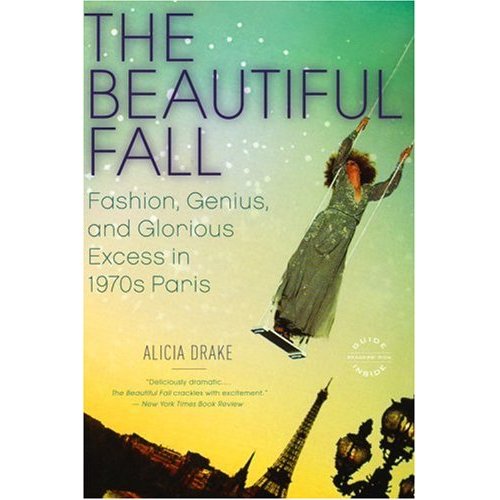
Framing the Modern Fashion Mythos: The Beautiful Fall

I had a post ready for today about bridal showers. I have to go to one today and I was racking my brain for what to wear and decided that might be of interest to my readers. Key word is HAD, however, as my computer just swallowed it whole.

So, instead we are going to do a short and sweet review of one of the greatest books in modern fashion history.

51G4f4PtsIL._SS500_.jpg

One of my favorite books to read about fashion is The Beautiful Fall by Alicia Drake. It has provides great insight into how ready to wear came to dominate the fashion scene and how all the major players came to be. The main focus of the book is on the relationship between Karl Lagerfeld and Yves Saint Laurent, and if that is not your cup of tea it is still worth a read for the decadent descriptions of fashion in the 70s.

The reason I decided to do a post about this book in particular is that we all come into fashion differently. I came in via stories - well one in particular. My best friend and I were watching television one day and the history channel was doing a special on Coco Chanel. This was before the fashion craze went mainstream, and as such this was the first time I ever really heard of Chanel outside perfume.

Watching the program on a lark, I was in awe of her grit and determination to be the best despite her humble upbringing. She literally turned the fashion world on its head simply by being the best. That is no easy feat mind you and she did it all through sheer force of will. As you can imagine, I found her story to be mesmerizing and fell in love with fashion via Chanel that very day.

So, when I came across The Beautiful Fall I thought it was an amazing opportunity to learn about the man who took over the reigns: Karl Lagerfeld. I took away a lot more than I bargained for as I learned about all the ins and outs of the modern fashion business and its evolution from couture. In short, if you are interested in fashion it is a must read.

Normally, I would write more but I have to go pick my dress up for the bridal shower I have to attend today. Wish me luck as I have to endure a 1 hour commute in the rain to reach my destination in NJ. Let's just hope the PATH train isn't flooded by the time I get there.

Friday, March 5, 2010

The Plus Sized Fashionista's New Best Friend: the Millennial

Elitism in fashion is on its way out and we have the rise of the Millennials to thank for it.

Marketers are literally chomping at the bit to appeal these consumers aged 18-28 as they are considered to be the holy grail in this depressed economy. Why? They have the most disposable cash and are considered to be the tastemakers of today as well as tomorrow.


Millennials are different from other consumer groups as they are "eager to be entertained and informed yet [they] are resistant to the familiar...in-your-face 20th-century approach". They are a "generation of free downloads, easy access to everything — what the American psychologist Nathan Brody calls 'the entitled generation'". Brands, as such, have been forced to create new strategies to speak to these consumers in order to simply survive.

It is no wonder then that exclusive world of fashion has begun to open up lately - it has no other choice! That is why everyone recently is trying to get on the diffusion/capsule collection bandwagon, and also why we are seeing an increased presence of brands on the web outside of etail. Millennials, after all, are known for their love of wired interactive connectivity and brands as such are scrambling to catch up.


A prime example of this is Nowness a new website launched by LVMH. There are no products being directly sold on the site and no mention of the site's ownership by LVMH. In fact, the only press they get from the website is when a product from one of their lines is mentioned every so often. It may seem strange but the main goal of this website is to generate goodwill via remarkable experiential editorials, and also to stand as demonstration of the brand's commitment to their consumers opinions/interests. This is essential when marketing to Millennials as they will seek out other brands if they feel that they are being ignored, and in a market being propped up by their purchases their departure can be deadly blow.


So, what does this mean for the plus size fashionista you may be asking yourself? It means for the first time there is a chance new voices to be heard in fashion, and plus size voices are breaking through as we speak. Marie Claire was the first to jump on the bandwagon of plus size editorials by having plus sized columnist Ashley Falcon join their team. The blogosphere also is a heavy hitting sphere of influence in this regard as it is changing the way fashion is being viewed. Take Gabi of Young, Fat, & Fabulous - she is now vlogging for Vogue Italia Curvy, which is a whole website owned by Vogue Italia devoted to plus size high fashion. Or the fact that Stéphanie of Le Blog de Big Beauty is being paid to create a plus size collection for La Redoute.

I mean I know we still have a long way to go until parity is reached, but for the first time in a long time it actually feels like my voice is being heard.

Sunday, February 14, 2010

Fashion's Dirty Secret: The Plus Size Fit Conundrum

plussizemannequin.JPG
Confession Time: I went to Parsons the School of Design because I wanted to establish a plus size brand that would appeal to all you chotto coquette's out there.

While pursuing my degree it became apparent that it just was not in the cards as I had serious misgivings about entering the market. One of the main issues that dissuaded me from doing so was the ability to create an appropriate fit for a plus size clothing line.

Why did it? The majority of designers only have access to "straight size" models, dummies, virtual size models, and body measurement data. This is the very reason that you see the people on Project Runway literally weeping when they have to use "real women" instead of models. They have no idea how to approach these body types as they have only learned how to design for a certain size range.

The designers themselves are also not always to blame for this either. In short, it is the costs associated with learning to design and produce an extended size range that is to blame. The additional investment needed is cost prohibitive for many designers, and as such there is a lack of ability to design for plus size frames.

VMagazine_OneSizeFitsAll.jpg

That is also why more often than not many plus size items are "super sized" versions of straight sized styles, and it also accounts for the atrocious fits that abound in the plus size market. As for right now, there is hope that this will change in the future thanks to a joint project by Bekleidungsphysiologische Institut Hohenstein and the Institute of Textile Machinery and High Performance Material Technology at Dresden's Technical University.

They recently just released the results from their study on the measurements of the plus size frame in regards to optimum clothing fit. This is a groundbreaking study as it is the first time "the body measurements of the full-figured [were] comprehensively measured and evaluated scientifically".

What exactly does this mean for plus size shoppers?

"As a result of this effort, the garment industry will have current body measurement data, guidelines for optimised designs, and realistic busts in the form of virtual size models". In short, this means that now ready-to-wear markets will have more accurate information on fits and as such will be able to create clothing that not only fits a plus size frame better but also flatters it as well. Whether they chose to, however, is a completely different subject altogether.